
Rare Luzon Bleeding-heart Pigeon Spotted in Ifugao Backyard
AI-assisted original article by One News Desk, based on reporting from GMA News Online. Featured image credited to the source.
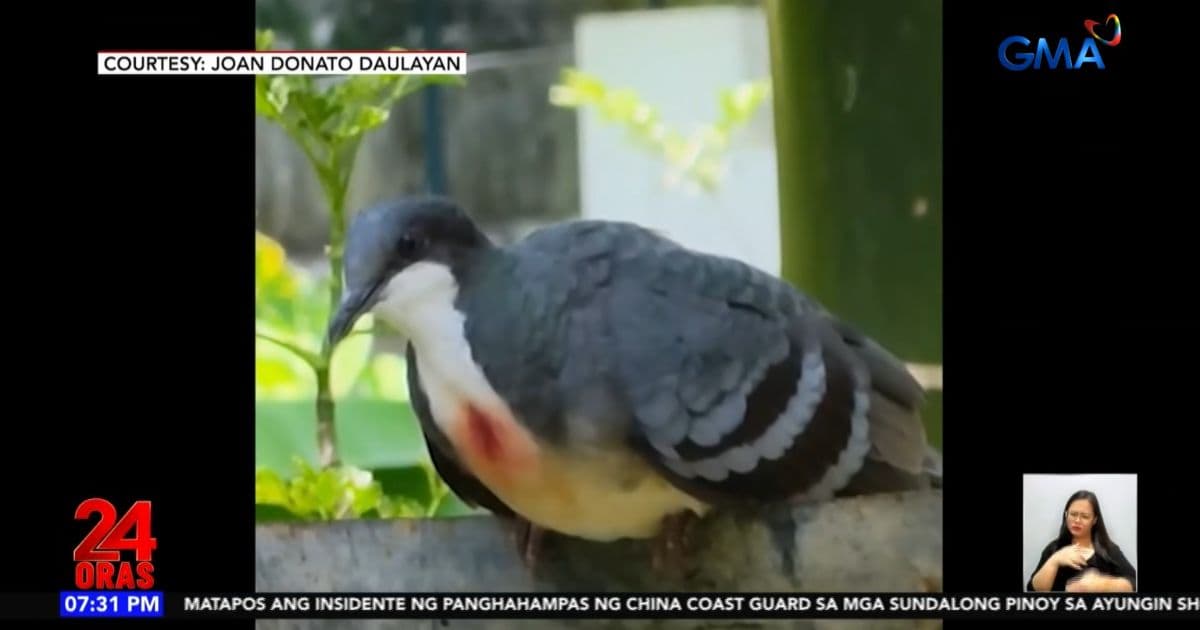
In a remarkable encounter, a woman in Asipulo, Ifugao, initially mistook a bird that landed in her yard for an injured creature due to the striking appearance of what seemed to be blood on its chest. Joan Donato Daulayan reported her experience on the television program "24 Oras," where she shared her initial concern about the bird's condition.
Instead of intervening, Daulayan and her family chose to observe the bird from a distance and sought assistance online to identify the unusual visitor. Their caution paid off when they discovered that the bird was not injured at all. The vivid red coloration on its chest was actually its natural plumage, identifying it as a Luzon Bleeding-heart, scientifically known as Gallicolumba luzonica, a species endemic to the Philippines.
The Luzon Bleeding-heart is named for its distinctive crimson chest, which resembles a bleeding wound. This species is one of five types of bleeding-heart pigeons found in the Philippines. Among the others are the Mindanao Bleeding-heart (Gallicolumba crinigera), which is known for having the largest and brightest red chest patch, and the Negros Bleeding-heart (Gallicolumba keayi) and Mindoro Bleeding-heart (Gallicolumba platenae), both classified as critically endangered. The Sulu Bleeding-heart (Gallicolumba menagei) is considered potentially extinct.
Locally referred to as Puñalada or Paloma de Puñalada, meaning "stabbed pigeon," the Luzon Bleeding-heart is recognized as one of the country's most iconic endemic birds. According to wildlife expert Kuya Kim, sightings of this species in the wild are rare, as they are known to be shy and elusive. These pigeons typically inhabit dense forest undergrowth and prefer to hide among vegetation when threatened rather than take flight.
In a separate incident, a family in Majayjay, Laguna, experienced their own unexpected wildlife encounter. After hearing unusual noises from the second floor of their home, they initially feared a burglary. Allen Florendo recounted the moment, saying, "We thought na may magnanakaw. Kumuha kami ng pamalo tapos binuksan namin 'yung pinto," which translates to, "We thought there was a thief. We grabbed a stick and opened the door."
To their astonishment, the source of the noise was not a burglar but a bird pecking at their tinted window. Florendo speculated that the bird may have mistaken its reflection for another bird, explaining, "'Yung window namin is tinted. Nakita niya siguro 'yung reflection niya kaya niya tinutuka 'yung window namin," meaning, "Our window is tinted. It probably saw its reflection and started pecking at it."
According to Kuya Kim, this bird is identified as a Rough-Crested Malkoha, a member of the cuckoo family that is also endemic to the Philippines. Such encounters highlight the rich biodiversity present in the region and the importance of understanding and protecting these unique species.
The Luzon Bleeding-heart, with its striking appearance and elusive nature, serves as a reminder of the diverse wildlife that inhabits the Philippines. Conservation efforts are crucial to ensure the survival of such species, especially as habitat loss and other environmental threats continue to pose challenges to their existence. As more people become aware of these birds, there is hope for increased protection and appreciation of the country's natural heritage.